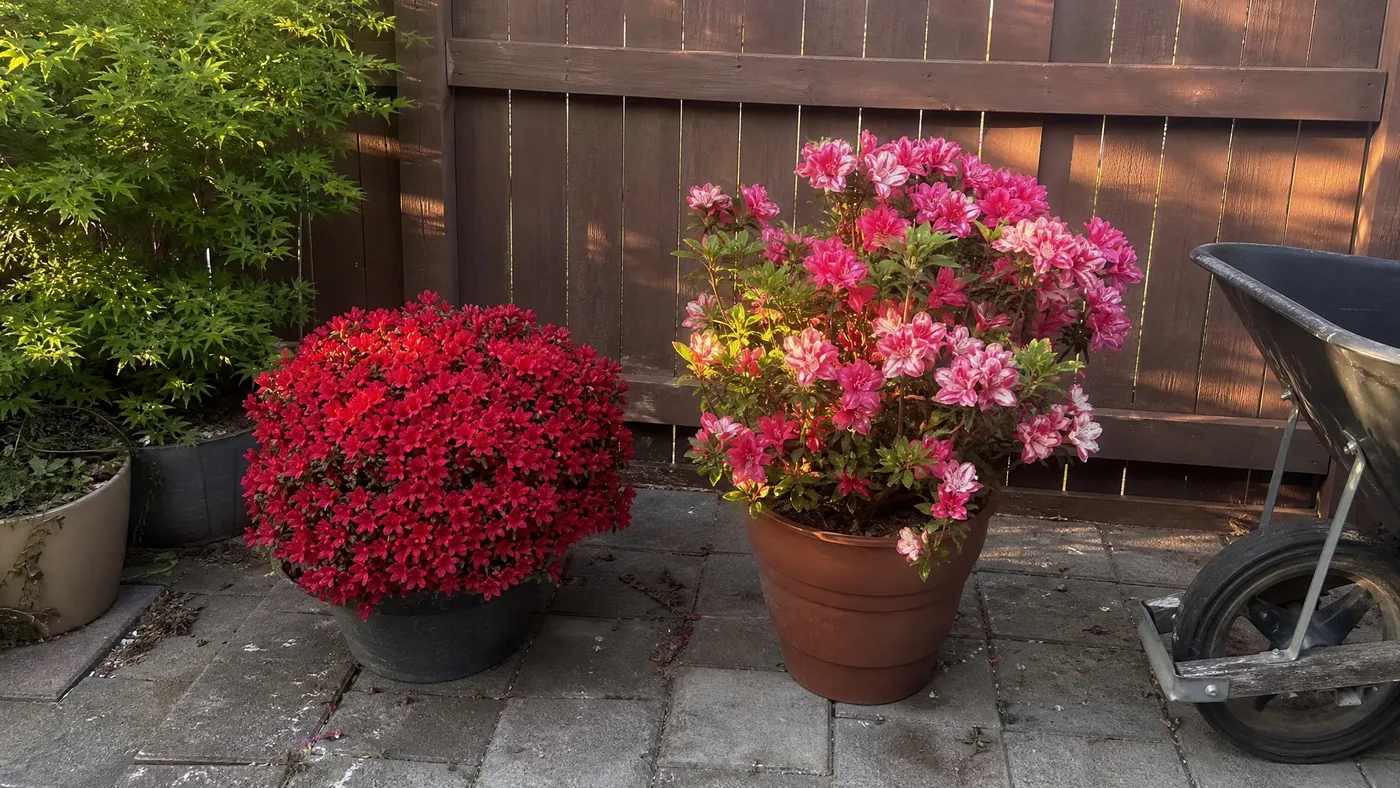
Hino Crimson Azalea vs Azalea Japonica
Picture a spring when you bring home two shrubs under the same Azalea japonica tag. One is Hino Crimson and the other is something else entirely. By the time they bloom they are weeks apart on the calendar and nothing alike in shape. The tag promised a matched pair, so you gave them the same spot, the same pruning, and the same expectations.
That is what a wrong classification does to a plant. A Kurume hybrid gets planted for hardiness it may not have, sheared like a shrub twice its size, or written off as a failure when it is simply behaving like itself. In this article, we'll go through how the japonica label got attached, what the abbreviations on a tag mean, and where Hino Crimson truly differs from a japonica-type azalea.
Hino Crimson Kurume Azalea Under a Japonica Label
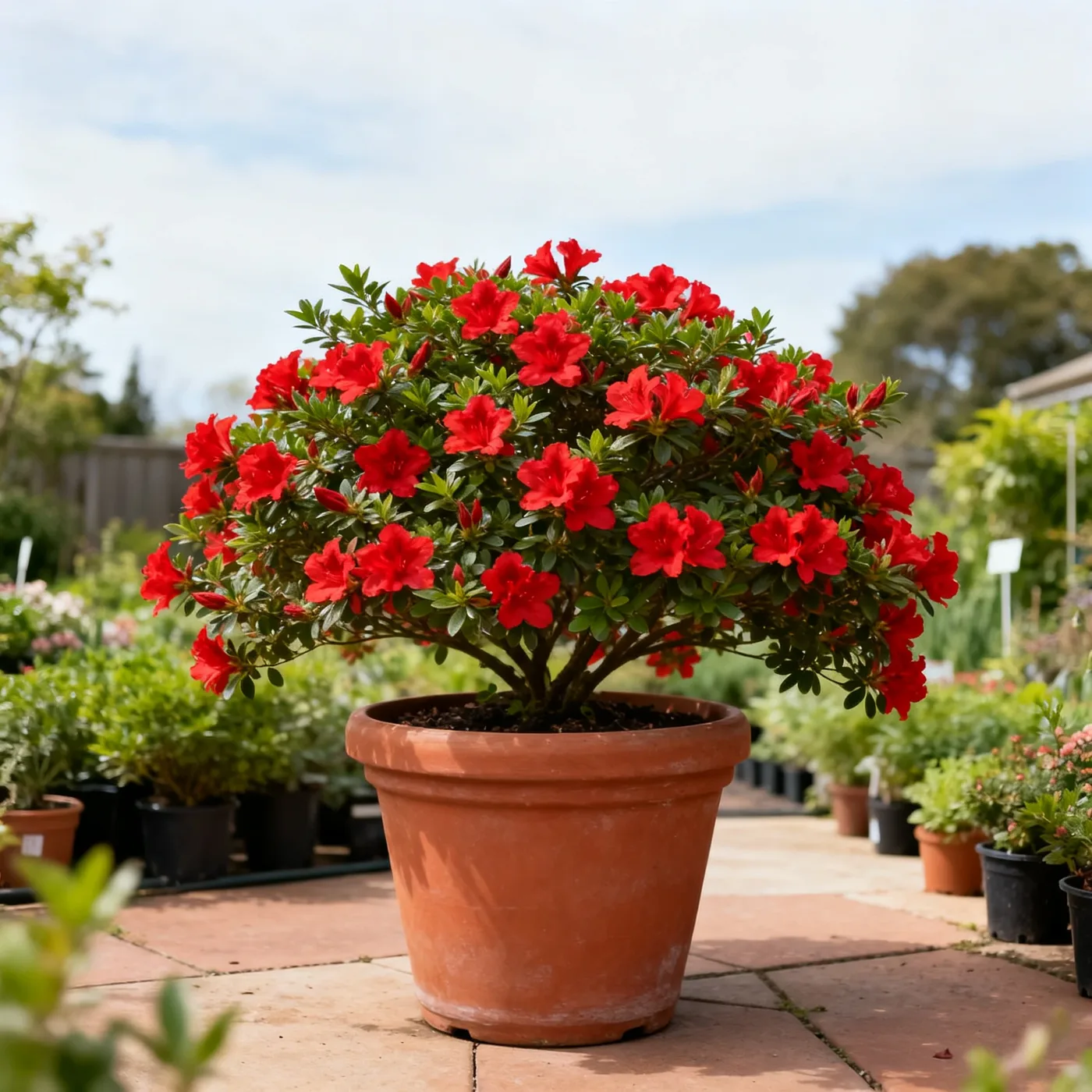
Hino Crimson is a compact, spreading evergreen azalea with small, mid-green leaves and funnel-shaped, bright crimson flowers just over an inch across, borne in mid to late spring. Nothing in that description says japonica. Yet search the name and you will find it filed under "Azalea japonica" on site after site, and that matters because the tag is the only thing most buyers read before they plant.
What the Wrong Tag Sets Up
A japonica tag sends you shopping for a different plant than the one you get. You space it for a larger shrub, pick companions to match, and then wonder why the bed looks sparse. Hino Crimson is low and flat-tiered, and it is smaller and lower growing than 'Hinode Giri'. Its ultimate height is only 4 to 20 inches.
What Does Not Change With the Label
Whatever the tag says, the plant's own needs stay put: moist but well-drained, leafy, humus-rich acid soil, in half to full sun. The label changes the decisions that depend on identity, which are hardiness, pruning habits, and what you compare the plant against. For the full size picture, our guide on how big a Hino Crimson gets lays out the numbers.
Old Nursery Names Against the Botanical Record
One of the most common questions we get is why the same shrub carries three different names on three different websites. The answer is mostly inertia. Catalogs copy from older catalogs, growers reuse tag files, and once "japonica" is attached to an evergreen azalea it tends to travel, because nobody downstream has a reason to check it against a botanical reference.
The trade has long used "japonica" loosely for Japanese-type azaleas, which is exactly why it fails as an identifier. A word that covers many plants cannot tell you which one is in the pot, and when the real plant is a named cultivar, a loose word hides the one thing you most need to know.
What the Record Says
The botanical record is more specific. Oregon State's plant database calls Hino Crimson a Kurume evergreen azalea, developed in New York about 1940. So despite what many catalogs imply, this cultivar was not bred in Japan, and "Kurume" points to a group rather than a birthplace. The group itself became known in the West through E. H. Wilson, who brought 50 cultivars to the Arnold Arboretum in 1919.
Which Source to Trust
Our rule is plain. When a nursery tag and a botanical garden disagree, we go with the garden, because those entries are built to be checked. A tag only has to fit on a stick in a pot. This plant is a Kurume type, and it is not a japonica of any kind.
Decoding Hino Crimson Kurume Azalea Tag Abbreviations
Abbreviations are where tags get most confusing, because there is no single standard and each nursery shortens things its own way. A useful anchor is the listing titled 'Hino-crimson' (Kurume) (EA), where EA stands for evergreen azalea. Nearly all the shorthand you will meet is a variation on those same two ideas, evergreen and Kurume.
A Tag Decoder
The table below is how we read the common shorthand. Treat it as a guide to intent, and ask the seller when a tag uses something you cannot place.
| On the tag | How we read it | Fits Hino Crimson? |
|---|---|---|
| ev or EA | Evergreen azalea | Yes, it keeps its leaves and turns bronze in winter |
| ku or Kurume | The Kurume hybrid group | Yes, this is its group |
| (j) or japonica | A loose catalog label | No, a mislabel |
| obtusum | An older species-style name | Outdated, see below |
When a Tag Contradicts Itself
Many tags carry two signals at once, such as "ku" and "(j)" side by side. Trust the signal that matches the plant. Evergreen and Kurume describe real traits, while "(j)" describes nothing you can check. Hino Crimson holds its leaves through winter, so the evergreen reading is easy to test on a plant in a pot.
Ours go out labeled as the Kurume hybrid they are, and our buying guide explains what to look at on a plant in a container.
Rhododendron Obtusum Then, Kurume Hybrid Now
Search "rhododendron obtusum 'hino-crimson'" and you will land on a name that still turns up on older tags and in old catalogs. It reads like a species name, and that is the problem. A species name implies one wild plant behind the shrub, and Hino Crimson does not have one. We would drop obtusum from any tag we printed.
Why a Species Name Does Not Fit
The Kurume group is named for a city on the island of Kyushu, and the hybrids are believed to derive from evergreen azalea species in the southern part of the island. Note the plural. A group built from several species cannot be filed under any one of them, and a cultivar from that group inherits the same problem.
What a Group Name Tells You
Azalea groups are identified by the name of a hybridizer or some other affiliation, not by species, so "Kurume" tells you which family of evergreen azaleas to compare the plant against. Our guide to Hino Crimson against other Kurume azaleas does that comparison.
Written correctly, the plant is Rhododendron 'Hino Crimson', followed by the group in parentheses. The single quotes mark a cultivar, and the parenthetical marks the Kurume hybrid group. That is the current classification, and it is the only one that matches the botanical record.
Where Hino Crimson Kurume Azalea Differs From True Japonica
Set Hino Crimson beside a plant that truly descends from R. japonicum and the differences start with the leaves. R. japonicum is the parent species of the Mollis deciduous azalea hybrids, so that side of the family drops its leaves in autumn. Hino Crimson is evergreen, with small, glossy green leaves that turn bronze in winter. That one trait settles most mislabeling arguments on its own.
Size and Habit
Hino Crimson is low and compact, with flat-tiered branching, and its ultimate height and spread are 4 to 20 inches. Some listings quote much taller numbers, so measure the plant in front of you. Our sources give no figures for japonicum-derived plants, so check with your local extension service before you plan spacing against one.
Bloom and Cold
The flowers come in mid to late spring, which is a UK timing, so your own calendar will shift it. The color is a bright red that does not fade. Our bloom time and flower color guide covers how that plays out locally.
Hardiness is where the figures split. Oregon State says Hino Crimson is hardy to Zone 7, though Zone 5 is also quoted. We plan on Zone 7 and treat a colder placement as a gamble that needs shelter, and our hardiness zone guide goes deeper.
Checking the Plant Itself
Before you pay for any azalea sold under a japonica tag, run these checks against the pot:
- Look for small, glossy leaves that stay on the plant in winter. A shrub of bare twigs is not a Kurume.
- Look at the habit, which should be low, spreading, and tiered rather than upright and open.
- Look for bright crimson flowers that hold their color, not a washed-out shade.
- Ask which hardiness zone the seller means, and what source they are using for it.
Our choice is plain. We would pick Hino Crimson for anyone who wants evergreen structure in winter and a sheet of crimson in spring from a small footprint. If you want a deciduous azalea, buy one labeled deciduous and do not let a japonica tag decide for you.
A Japonica Spring Remembered Beside a Kurume Spring
In our rows, the clearest lesson came from growing a Kurume and a deciduous azalea side by side through a full year. By late winter the Kurume was still dressed in glossy bronze leaves while its neighbor stood in bare twigs, and when spring arrived the Kurume disappeared under crimson. The deciduous one kept to its own timetable, and the two never lined up for a photograph.
Winter and Early Spring
Bronze in winter is normal for Hino Crimson, and it is one of the plant's quieter pleasures. What should worry you is a leaf that stays pale or yellows between the veins once growth starts, because that points to soil that is not acid enough or drains badly, not to a classification problem. The plant wants moist but well-drained, humus-rich acid soil, and it holds you to it.
The Weeks of Bloom
When Hino Crimson opens, the flowers cover the low mounds so thoroughly that the foliage nearly vanishes, and because the color is non-fading it stays rich from the first bloom to the last. After flowering the leaves return to glossy green. A deciduous azalea gives you a different kind of spring, with flowers on bare branches or alongside fresh leaf, and both are lovely, though neither is the other.
Hino Crimson Kurume Azalea, Named Correctly at Last
Written correctly, the plant is Rhododendron 'Hino Crimson' (Kurume hybrid group), an evergreen azalea developed in New York about 1940 within a group named for Kurume, a city on Kyushu. It is not a japonica, not an obtusum, and not bred in Japan, whatever an old tag claims. Every tag that gets it wrong is usually repeating an older one.
The practical result is a low, evergreen shrub that is bronze in winter and bright crimson in mid to late spring, with a hardiness claim you should verify for your own zone. Before you buy any azalea, read the tag against the plant in front of you, and trust the leaves, the habit, and the flowers before you trust the label.
Hino Crimson Kurume Azalea
Nursery-grown Hino Crimson Kurume Azalea in sizes from 3 Gallon, shipped to your door.
From $79.95
Shop Now →Hino Crimson is a shrub we know well, since it spends its whole young life in our beds of moist, free-draining soil rich in leaf humus and acid in reaction, where it gets sun from morning through to mid-afternoon at least. A small business that raises its own top-quality shrubs can tell you plainly what it is selling, and ours is a Kurume hybrid, not a japonica. If you are ready to compare a true one against the tag you have been given, browse what is in stock now.