Vine Weevils on Hino Crimson Kurume Azalea: Spot It and Treat It
Put two columns side by side. In the first, list what it costs to replace a mature Hino Crimson Kurume Azalea: the new plant, the years it takes to fill the same space, and the bloom you lose in between. In the second, list what it costs to watch for one small beetle over a few seasons: a strip of burlap, a flashlight, and a few minutes a week.
The first line item in that second column is a notched leaf edge, and it shows up well before any wilting does. In this article, we'll go through how to confirm the notching, check the roots, decide how much monitoring the plant deserves, choose a grub treatment and an adult treatment, and spread the cost across three years. The larvae in the soil do the real harm, and they favor azaleas, so a little attention early is the cheaper path.
Is That Notching on Hino Crimson Kurume Azalea Weevil Work?
Start with the leaf edge, because this is the cheapest evidence you will ever collect. Adult black vine weevils feed along leaf margins and leave distinctive hemi-spherical notches, smooth scallops that look cut with a tiny punch. Hino Crimson carries small, glossy green leaves, so each notch stands out clearly against the blade and is easy to read from a few feet away.
That is a real advantage over larger-leaved shrubs, where a few bites vanish into the foliage. On a compact Kurume plant, the same bites read like a row of tiny bite marks along a branch, and you can tell at a glance whether the damage is fresh or old.
Rule Out the Look-Alikes
Look at the pattern before you decide. Weevil notches sit on the margin, run in a curved arc, and appear on many leaves along a branch. These signs point somewhere else:
- Tunnels or pale blotches between the leaf surfaces suggest leafminers, not weevils. See our guide to leafminers on Hino Crimson.
- Chewing that starts in the middle of the blade, or whole sections of leaf missing, points to a caterpillar or another chewer.
- Yellowing or stippling without any bite marks is a different problem. Our list of common Hino Crimson problems covers the rest of the look-alikes.
Check After Dark
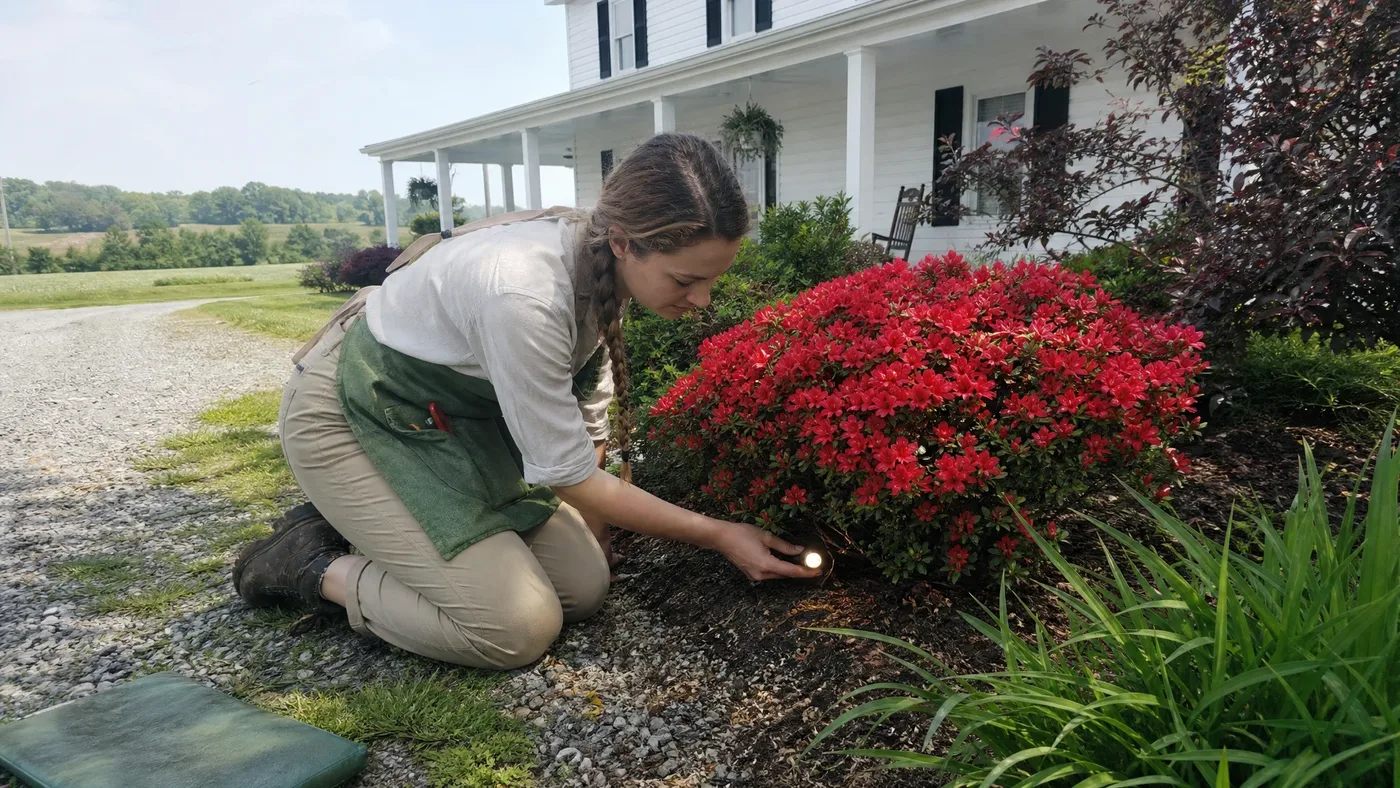
Adults feed at night and hide by day, so a daytime walk-through can miss them entirely. Take a flashlight out an hour or two after dusk in early summer and look at the foliage and the base of the stems. Dark, hard-bodied beetles on the plant settle the question.
The choice: if you find even a handful of fresh notches in a Hino Crimson, treat it as a weevil diagnosis and move on to the roots. Do not wait for a second symptom, since the leaves are the only warning you get.
Digging Up the Roots Before Spending Anything
Notched leaves tell you adults visited. They do not tell you whether grubs are already eating the roots, and that is the question that decides what you spend. The UC IPM program notes that larvae do the most serious damage, chewing on basal crowns and roots, and that larval feeding can kill or weaken azalea and rhododendron in particular. Hino Crimson has a shallow, fibrous root mass, so there is little buffer once the grubs start.
One of the most common questions we get is why a plant wilts when the watering has been right. Dry-looking leaves on moist soil are the classic sign that the roots can no longer carry water, so check them before you change your watering. Our watering guide helps you rule out the simpler causes first.
How to Check the Root Zone
Do this on a cool day, and work gently so you do not add stress to a plant that may already be struggling.
- Pull back the mulch on one side of the plant and dig a small wedge just outside the stems, as deep as the root mass.
- Crumble the soil in your hands and look for creamy white, legless, C-shaped grubs.
- Inspect the fine roots and the crown at the soil line for chewing or bark stripped from the base.
- Refill the hole, firm the soil lightly, replace the mulch, and water it in.
Larvae feed on fine roots in the fall and on larger roots in spring, so both seasons are fair times to look. Dig on the side of the plant with the most notching, since that is where the adults have spent the most time.
Read What You Find
Healthy fine roots are pale and plentiful, and they hold the soil together in a loose mat. Roots that are missing, severed, or so sparse that the soil falls away from the plant are the signature of grub feeding. A single grub in a small dig is still a finding, because larvae rarely occur alone.
The choice: if you find grubs, treat the soil now. If the roots are intact and you find nothing, do not treat, but keep monitoring for adults and dig again in a month or two.
How Much Watching Hino Crimson Kurume Azalea Deserves
Monitoring is where the budget is decided, because it costs time rather than money. The question is how many weeks of your summer a single shrub is worth. A plant that anchors a bed, or one you have grown for several years, justifies more than a spare in a back corner. In our rows, the plants that get caught early are the ones someone walked past regularly in June.
Three Levels of Effort
Light: inspect leaf margins once a week from early June through July. This costs nothing and catches most problems, but it only tells you adults have arrived, not how many there are.
Standard: add a trap. Wrap burlap or cardboard loosely around the base or lower stems at the end of May. Adults crawl under it overnight, and you check it weekly from mid-June. The UMass Extension fact sheet has you collecting adults weekly from mid-June through August.
Thorough: add a buried cup near the base as a pitfall trap, plus an occasional night walk with a flashlight. UC IPM lists both wraps and pitfall traps as monitoring options, and using both gives you two independent counts.
What a Count Tells You
A trap is a thermometer, not a cure. One or two beetles in a week means adults are present at a low level, and you can keep picking them. A steady stream, week after week, means a local population large enough that egg-laying is likely. That is your cue to dig for grubs in late summer and fall, and to plan the soil treatment in the next section.
The choice: we tell customers to take the standard level for any established Hino Crimson and the light level for a plant they could replace without much regret. A missed season can mean a season of larvae, which is the most expensive outcome of all.
Nematodes, Drenches, or Both for Soil Grubs
Once grubs are confirmed, the choice is between living and chemical controls, and the main difference is timing. Beneficial nematodes are microscopic worms that hunt larvae in the soil. UC IPM states that soil must be warm (at least 60°F) and moist but not soggy before you apply them and for 2 weeks afterward. They are timed from midsummer to fall, when larvae are present.
Why Nematodes Fit This Plant
Nematodes suit Hino Crimson when the soil is acidic, humus-rich and evenly moist, which is how the plant likes to be grown anyway. Our soil and pH guide describes that bed. They are living organisms, so follow the supplier's storage and mixing directions exactly and apply them in the evening or on a cloudy day. A cold or dry bed is the usual reason they fail.
When a Soil Drench Makes Sense
A chemical soil drench is the alternative when soil is too cold or dry for nematodes, or when you want a more predictable result. Products and registrations differ by state, so read the label for use on ornamental shrubs and ask your local extension office what is approved near you. Keep any drench away from ponds, drains and bare, sandy ground where it can run off.
The trade-off is plain. Nematodes cost more per treatment, only work in a narrow temperature window, and need the soil kept watered afterward. A drench is less picky about conditions, but it is a chemical product that depends on label compliance and local rules.
The choice: use nematodes if you can hold the soil at 60°F or warmer and keep it moist for two weeks. Choose a labeled drench if you cannot, or if grubs are already thick and the plant is wilting. Using both is rarely needed and doubles the cost.
Hand-Picking or Spraying Adults on Hino Crimson Kurume Azalea
Treating the soil protects this year's roots. Treating adults protects next year's, because every female you stop before she lays eggs is a clutch of grubs you do not have to treat later. Adults emerge in June and July, and that is the window for either method.
Hand-Picking
If you already run a trap, hand-picking costs nothing extra. Shake the wrap into a bucket of soapy water each week and do a flashlight round at night. It works well on a compact Hino Crimson, since every branch is within reach. Its limit is coverage, since you only catch the beetles you find, and the ones hiding in nearby plantings go on laying eggs.
Foliage Treatment
UC IPM says spinosad can be sprayed on leaves in the evening about 1 week after you first see adult chewing. Because of its short persistence, a repeat 7 to 10 days later may be warranted. Read the label for rates and bee precautions, and do not spray open flowers. Evening application keeps the product on the leaves when the beetles come out to feed.
Which Protects Next Year Better
Neither method is a guarantee, because weevils walk in from neighboring plants. Picking alone leaves gaps, while spraying alone only reaches beetles that feed on treated leaves. Used together on a plant with heavy notching, they give you the best odds that fewer eggs reach the soil.
The choice: hand-pick if you have one plant and the time. Spray if the notching is widespread or beetles keep returning after a week of picking. Either way, protection comes from catching adults before they lay, so start in June.
Rescue or Replace a Wilting Hino Crimson Kurume Azalea?
The wilt itself is not the deciding evidence. The state of the roots is. Plants can wilt and die from autumn to spring because larvae devour the roots, and container-grown plants are more susceptible. A shallow, fibrous root system leaves little reserve once grubs get into it.
When to Rescue
Rescue is worth trying when you find grubs but the plant still has a good share of its fine roots and the stems are firm and green at the crown. Treat the soil, then keep it moist but not soggy, give the plant some shade, and hold off on fertilizer until new growth appears. The cost is a treatment and probably a few seasons of slow recovery, with a thinner bloom meanwhile.
Do not prune hard to compensate. A plant with fewer roots needs its leaves to rebuild them, so leave the foliage alone. Our complete care guide covers the routine to return to once new growth shows.
When to Replace
Replace when the plant lifts from the soil with almost no root, or when the bark is stripped at the crown. A girdled stem cannot be repaired. Remove the old plant and as much of the soil around it as you can. Then treat the planting hole before a new azalea goes in, following our planting guide. If you replace it, we grow Hino Crimson in containers and can supply a healthy plant.
The choice: rescue if the crown is sound and roots remain, since the cost is a few seasons of patience. Replace if the crown is girdled or the roots are gone, since delay only adds to the cost.
A Three-Year Weevil Budget for Hino Crimson Kurume Azalea
Here is how the choices fit together over three years. The table lists qualitative costs because prices vary by product and region, but the pattern holds: the heaviest spending comes early, then it falls.
| Year | What to do | Relative cost |
|---|---|---|
| 1 | Confirm with a root check, treat grubs, set a trap by late May, pick or spray adults | Highest |
| 2 | Repeat the trap and weekly checks, treat the soil only if you find grubs | Low |
| 3 | Trap and check leaf margins, with one root check in fall | Lowest |
Repeat the trap and the weekly leaf inspection every year, because they cost almost nothing and are what tell you whether the money spent earlier worked. A root check once a year, in fall or spring, is the safety net.
The cost drops off once you have two seasons with no fresh notching and no grubs in your digs. At that point, you can go back to the light level of monitoring. If notching returns, step back up to the standard level for a season rather than waiting to see.
Why Steady Watching Costs Less Than Replacing Hino Crimson
Run the three years as a ledger. Replacement is one large purchase, followed by years of waiting for the new shrub to reach the size and bloom you lost, and nothing stops the same weevils from returning to the new plant. Monitoring is a small, repeated cost, and it protects both the plant and the money you have already spent on it.
Look for the notches in June, check the roots before you buy anything, and match the treatment to the soil temperature and the life stage in front of you. Do that for three seasons and the steady, low-cost routine comes out ahead of a single replacement shrub.
Hino Crimson Kurume Azalea
Nursery-grown Hino Crimson Kurume Azalea in sizes from 3 Gallon, shipped to your door.
From $79.95
Shop Now →Each Hino Crimson here spends its early life in our beds, where the soil is dark with leaf mold, acidic, evenly damp and quick to drain, and the light runs from part shade to full sun. Because we are a small business that grows its own top-quality shrubs, we know exactly how clean a root system should look when a plant first reaches you. Once you know what to watch for, see what's in our shop right now and pick a fresh start.